Robotics & Cobots
Turnkey robot and cobot cells — integrated, guarded, and handed over programmable.
Detail sheet
How we build it
Every deployment is documented to the last terminal, so your team can own it the day we hand it over.
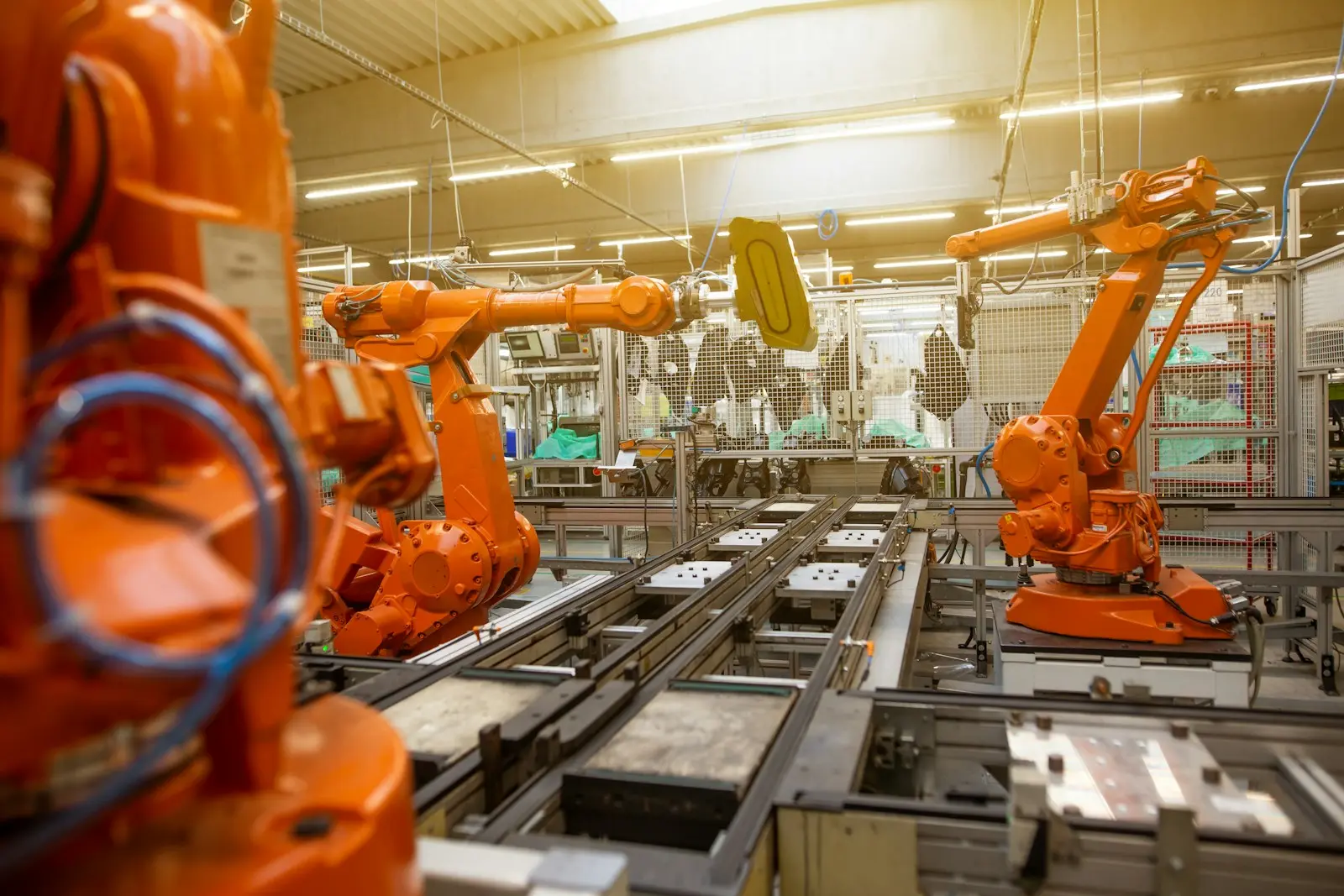
We integrate industrial robots for assembly, welding, palletising and material handling, and collaborative robots for the stations where a fence is not practical and a person still needs to be there. The robot itself is rarely the hard part. The cell around it — tooling, fixturing, part presentation, safety, and the handshake with the line controller — is what decides whether it runs unattended or needs someone standing next to it.
- Types
- 6-axis, SCARA, delta, collaborative
- Applications
- Assembly, welding, handling, palletising
- Safety
- Risk assessment and validated stop functions
In detail
What you should know
How this building block behaves in a working plant, and where it fits.
The cell is the project
A robot arm is a solved problem. Presenting the part to it in a known position every cycle, gripping something that varies, and clearing the fault when one unit arrives skewed — that is where the engineering time goes, and where cells that were sold on cycle time quietly fail to reach it.
We design the fixturing and part presentation before committing to a reach and payload, because the wrong answer there cannot be corrected by a bigger robot.
Collaborative does not mean unassessed
A cobot removes the fence, not the risk assessment. Force and speed limits have to be established against the actual tooling — a compliant arm carrying a sharp gripper is not a collaborative application, whatever the arm is rated for.
We do the assessment with your safety officer and design the stop functions and speed zones to what it concludes, rather than assuming the robot's own rating settles the question.
Handed over programmable
Cells get moved, retooled and repurposed. Programs are structured so a new part or a new position is a change to data, not a rewrite of the motion, and your team is trained on making those changes.
A cell only your integrator can modify is a cell that gets scrapped rather than redeployed when the product changes.
Applied
Where it earns its place
- Machine tending and part transfer between stations
- Palletising and end-of-line case handling
- Welding and dispensing where repeatability beats reach
- Collaborative assembly and inspection alongside operators
- Replacing hard automation on lines that now run more variants
What ships with it
- Cell layout, reach and cycle-time study
- Tooling, gripper and fixturing design
- Safety risk assessment and validated stop circuits
- Structured robot program with documented part data
- Operator and changeover training
Common questions
- Robot or cobot for our station?
- If the station can be fenced and the cycle time matters, a conventional robot is faster and usually cheaper. Cobots earn their place where a person has to share the space or the layout cannot take a guard.
- Will it hit the cycle time you quote?
- We quote from a reach and motion study, not a catalogue figure, and we tell you which assumptions it depends on — chiefly how consistently the part arrives.
- Can we reprogram it ourselves afterwards?
- Yes. Programs are written to be changed and we train your team on it. That is the point of the handover.
Elsewhere in the stack
Other solutions
The layers above and below this one — most projects use three or four together.